
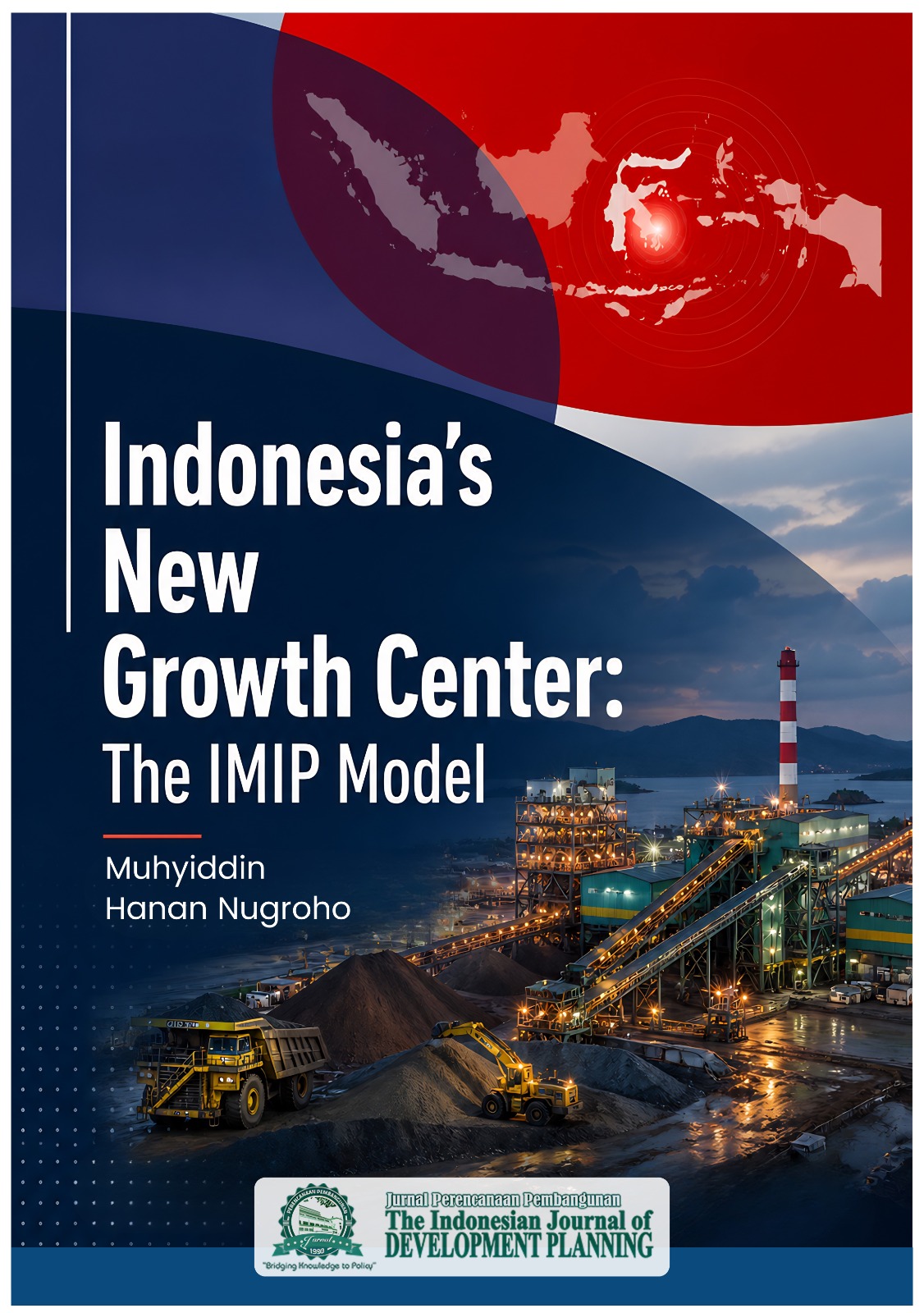
When Urbanization Outpaces Infrastructure: Spatial Concentration and Delayed Labor Absorption in Bahodopi, Indonesia
DOI:
https://doi.org/10.36574/jpp.v10i1.839Keywords:
Urbanization, Infrastructure Lag, Spatial Concentration, Employment Elasticity, Boomtown Urbanization, IndustrializationAbstract
Rapid industrialization in resource-based economies often generates substantial economic gains but may also produce significant urban challenges. This study examines the urban transformation of Bahodopi, Indonesia, a rapidly industrializing region driven by large-scale nickel downstream processing and industrial park development.
Using an original panel dataset, the paper integrates three complementary analytical approaches: a novel Urban Pressure Index (UPI), Difference-in-Differences (DiD) estimation, and employment elasticity analysis. The findings reveal three central dynamics. First, urbanization is highly spatially concentrated, with Bahodopi experiencing disproportionately large population growth relative to surrounding areas following industrial expansion. Second, urban pressure has increased significantly, as population growth has outpaced infrastructure capacity, leading to the emergence of an infrastructure lag trap. Third, employment elasticity remains low and volatile in the early stages of industrialization, indicating capital-intensive growth with delayed labor absorption.
These results characterize Bahodopi as a resource-based boomtown undergoing asymmetric urban transformation, where rapid economic expansion is not matched by corresponding improvements in urban systems. The study contributes to the literature by introducing the Urban Pressure Index as a tool for quantifying infrastructure–population imbalances and by providing empirical evidence on the urban consequences of industrialization in emerging economies.
Building on these findings, the paper advances the concept of a livable industrial city, emphasizing the need to integrate industrial development with spatial planning, infrastructure provision, and social inclusion. The results underscore that the success of industrialization should be evaluated not only in terms of output growth but also in relation to the capacity of urban systems to support sustainable and inclusive development.
Downloads
References
ADB. (2024). Development Effectiveness Review 2024. Asian Development Bank.
http://dx.doi.org/10.22617/SGP250140-2.
Ahmed, S. (2023). Migration and urbanization dynamics in developing countries. Urban Studies, 60(8), 1452–1470.
Angel, S., Parent, J., Civco, D. L., & Blei, A. (2016). Atlas of urban expansion. Lincoln Institute of Land Policy.
Baldwin, R., & Forslid, R. (2019). Globotics and development. Journal of Economic Geography, 20(1), 1–15.
Bridge, G., Bouzarovski, S., Bradshaw, M., & Eyre, N. (2013). Geographies of energy transition: Space, place and the low-carbon economy. Energy Policy. 53. 331–340. 10.1016/j.enpol.2012.10.066.
Calzada, I. (2023). Smart industrial cities in the global economy. Cities, 136, 104234.
Chen, Y. (2022). Agglomeration economies and regional inequality. Journal of Economic Geography, 22(3), 567–589.
Collier, P. (2022). The future of capitalism. HarperCollins.
Cust, J., & Harding, T. (2023). Resource-driven urbanization. World Development, 161, 106102.
Duranton, G., & Puga, D. (2020). The economics of urban density. Journal of Economic Perspectives. 34 (3): 3–26.
Fox, S. (2022). Informal urbanization and development. World Development, 150, 105707.
Fujita, M., Krugman, P., & Venables, A. (2001). The spatial economy. MIT Press.
Glaeser, E. L. (2023). Urban economics (2nd ed.). University of Chicago Press.
Henderson, J. V. (2010). Cities and development. Journal of Regional Science, 50: 515-540. https://doi.org/10.1111/j.1467-9787.2009.00636.x
IEA. (2023). Critical Minerals Market Review 2023. International Energy Agency. Paris. https://www.iea.org/reports/critical-minerals-market-review-2023
IEA. (2025). Clean Energy Transitions Programme 2024. International Energy Agency. Paris. https://www.iea.org/reports/clean-energy-transitions-programme-2024.
IMF. (2024). World economic outlook: Policy Pivot, Rising Threats. International Monetary Fund.
Kim, J. (2023). Urban inequality and infrastructure gaps. Cities, 132, 103984.
Krugman, P. (1991). Increasing returns and economic geography. Journal of Political Economy, 99(3), 483–499.
Kuznets, S. (1973). Modern economic growth. American Economic Review, 63(3), 247–258.
Lee, K. (2023). Industrial upgrading. Research Policy, 52(1), 104567.
Lewis, W. A. (1954). Economic development with unlimited supplies of labour. Manchester School, 22(2), 139–191.
Lin, J., Krueger, A., Rodrik, D. (2011). New Structural Economics: A Framework for Rethinking Development. The World Bank Research Observer. 26. 193-229. 10.2307/41261429.
Liu, Z. (2023). Urban expansion in Asia. Habitat International, 134, 102789.
Muhyiddin, M., Wijaya, A. F., Putra, F., & Wike, W. (2024). Indonesia’s Job Loss Insurance Program (JKP): Evaluating Challenges and Opportunities for Worker Welfare and Market Integration. The Journal of Indonesia Sustainable Development Planning, 5(3), 266-277. https://doi.org/10.46456/jisdep.v5i3.634.
Muhyiddin, M., Wijaya, A. F. ., Putra, F. ., & Wike, W. (2025). Evaluating active labor market policy in Indonesia: A case study of the job loss insurance program. Edelweiss Applied Science and Technology, 9(6), 2751–2762. https://doi.org/10.55214/25768484.v9i6.8470.
Muhyiddin, M., Amrizal, M. D. R., & Wahyuningrat, J. (2026). Outlook Ketenagakerjaan Indonesia 2026–2029: Dari Bonus Demografi ke Tantangan Kualitas Pekerjaan. Bappenas Working Papers, 9(1), 113 - 129. https://doi.org/10.47266/bwp.v9i1.540.
Nguyen, T. (2023). Industrial zones and urban growth. Economic Geography, 99(2), 201–220.
OECD. (2023). Green industrial policy for the net-zero transition. OECD Publishing.
Park, S. (2024). Infrastructure deficits. Urban Affairs Review, 60(2), 355–378.
Perroux, F. (1955). Note on growth poles. Quarterly Journal of Economics, 69(2), 307–320.
Pereira, R. (2023). Transport stress. Transport Policy, 134, 120–130.
Rahman, M. (2024). Urban governance challenges. Cities, 140, 104567.
Sachs, J. D., & Warner, A. M. (2022). Resource dependence. Economic Journal, 132(641), 120–145.
Silva, F. (2024). Environmental degradation. Ecological Economics, 210, 107845.
Sovacool, B. K., et al. (2022). Energy transitions. Energy Research & Social Science, 90, 102456.
Stiglitz, J. E. (2017). Industrial policy, learning, and development. In J. Page & F. Tarp (Eds.), The practice of industrial policy: Government–business coordination in Africa and East Asia (pp. 23–39). Oxford University Press. https://doi.org/10.1093/acprof:oso/9780198796954.003.0002
Tan, H. (2023). Industrial zones. Regional Studies, 57(4), 678–692.
Torres, L. (2022). Resource-based urbanization. World Development, 152, 105793.
UN-Habitat. (2022). World cities report 2022: Envisaging the Future of Cities. United Nation for Human Settlement Programme.
UNDP. (2024). Inclusive Urban Futures: From Inequality to Opportunity. United Nations Development Programme. DOI: http://dx.doi.org/10.22617/SPR260040-2.
World Bank. (2023). World Development Report 2023: Migrants, Refugees, and Societies. World Bank. https://doi.org/10.1596/978-1-4648-1964-3.
Zhang, X. (2024). Industrial urbanization. Journal of Urban Economics, 140, 103456.
Zhao, L. (2024). Spatial fragmentation. Land Use Policy, 137, 106987.
Downloads
Published
Issue
Section
License
Copyright (c) 2026 Muhyiddin, Muhammad Dio Rhiza Amrizal, Achmanto Mendatu, Firman Hadi Firdaus, Misbakhul Akbar, Hanan Nugroho

This work is licensed under a Creative Commons Attribution-NonCommercial-ShareAlike 4.0 International License.
This open-access article is distributed under the terms of the Creative Commons Attribution-NonCommercial-ShareAlike 4.0 International License. Copyright © The Indonesian Journal of Development Planning