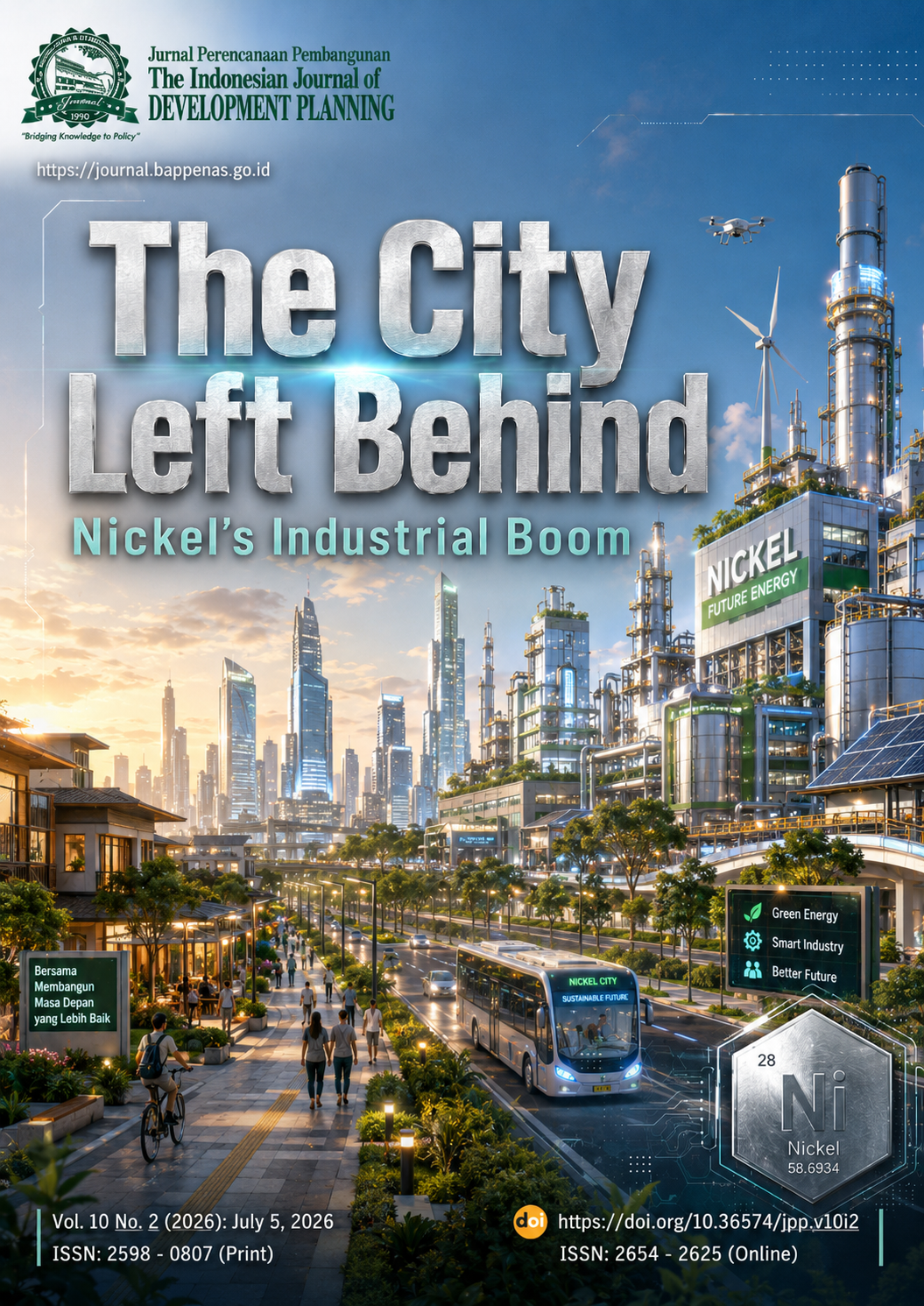
The City Left Behind Nickel's Industrial Boom
DOI:
https://doi.org/10.36574/Keywords:
industrialisation, nickel-processing industry, structural transformation, Indonesia Morowali Industrial Park, Regional Development, city and urbanAbstract
Over the past decade, Morowali and Weda have embodied the most spectacular face of Indonesia's industrialisation. Districts that barely registered on the national economic map have become the new epicentre of the world's nickel-processing industry. In Morowali, GDP growth has averaged well above 20% a year. The district's contribution to the economy of Central Sulawesi province has surged from roughly 5% to nearly 45%. This is not ordinary growth. It is a structural transformation of a kind rarely seen in the history of Indonesian regional development.
The numbers tell a striking story. Morowali's regional GDP has multiplied several times over. Investment has poured in. Factories, ports, smelters, power plants, production roads and industrial supply chains have risen with barely a pause. Weda, in North Maluku, follows a near-identical pattern. Nickel-based industrial zones have ceased to be accessories to the national economy; they are now its driving force within the minerals downstream strategy.
The cake is undeniably large. PT Indonesia Morowali Industrial Park (IMIP) has reported spending roughly 9 trillion rupiah (around $550m) a year on wages for local workers. With around 90,000 local employees, that works out to an average of some 8.3m rupiah per person per month—well above both the district minimum wage and Central Sulawesi's provincial floor. For a region that once depended on farming, fishing and petty trade, this represents a genuine social leap.
Downloads
References
-
Downloads
Published
Issue
Section
License
Copyright (c) 2026 Jurnal Perencanaan Pembangunan: The Indonesian Journal of Development Planning

This work is licensed under a Creative Commons Attribution-NonCommercial-ShareAlike 4.0 International License.
This open-access article is distributed under the terms of the Creative Commons Attribution-NonCommercial-ShareAlike 4.0 International License. Copyright © The Indonesian Journal of Development Planning