
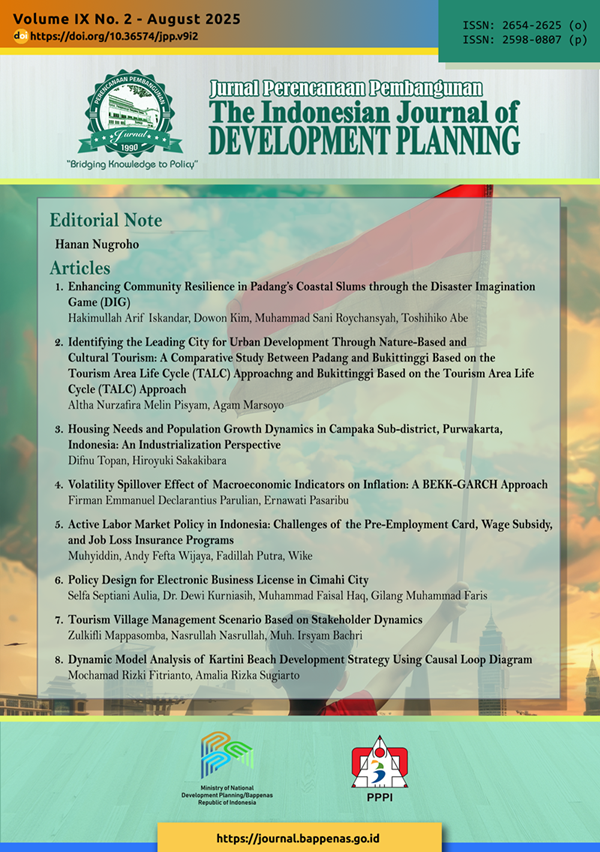
Housing Needs and Population Growth Dynamics in Campaka Sub-district, Purwakarta, Indonesia: An Industrialization Perspective
DOI:
https://doi.org/10.36574/jpp.v9i2.721Keywords:
Population Growth, Housing Needs, Share of Growth, Housing BacklogAbstract
This study examines the housing needs and population growth dynamics in Campaka Sub-district, Purwakarta Regency, Indonesia, an area characterized by rapid industrial expansion. The research applies the share of growth method to compare population growth between Campaka and Purwakarta Regency, revealing a consistently upward trend in Campaka’s demographic growth. Findings indicate a substantial gap between available housing supply and projected demand, with approximately 14,434 housing units estimated to be required by 2030. This demand can be met with a surplus of supply, which stimulates in-migration and accelerates the residential development. The analysis highlights the risks of unbalanced development when industrial growth outpaced housing provision, potentially leading to urban challenges such as overcrowding and infrastructure strain. The study recommends adopting a cautious approach to residential development, emphasizing the need for close monitoring of industrial activities and flexible adjustment of housing permits. Furthermore, active participation of local stakeholders in the planning process is considered crucial to ensure that housing policies align with community needs and long-term regional development objectives.
Downloads
References
BPS-Statistics of Purwakarta Regency. 2023a. Kabupaten Purwakarta Dalam Angka 2023. BPS-Statistics of Purwakarta Regency.
———. 2023b. Kecamatan Campaka Dalam Angka 2023.
Government of Purwakarta Regency. 2023. “Tujuh Zona Industri Purwakarta Daya Tarik Investasi Jawa Barat.” May 17. https://purwakartakab.go.id/read/2532.
Indonesia National Standardization Agency. 2004. Standar Nasional Indonesia Tata cara perencanaan lingkungan perumahan di perkotaan, issued 2004.
Leckie, Scott. 1989. “Housing as a Human Right.” Http://Dx.Doi.Org/10.1177/095624788900100210 1 (2). IIED3 Endsleigh Street, London WC1H ODD, United Kingdom: 90–108. doi:10.1177/095624788900100210.
Myers, Dowell, John Pitkin, and Julie Park. 2002. “Estimation of Housing Needs amid Population Growth and Change.” Housing Policy Debate 13 (3). Taylor & Francis Group: 567–96. doi:10.1080/10511482.2002.9521455.
Rayer, Stefan, and Y Wang. 2022. “Projections of Florida Population by County, 2025–2050, with Estimates for 2021.” Florida, USA: Bureau of Economic and Business Research 55.
Rowley, Steven, Chris Leishman, Emma Baker, Rebecca Bentley, and Laurence Lester. 2017. “Modelling Housing Need in Australia to 2025.” AHURI Final Report, no. 287 (August). Australian Housing and Urban Research Institute: 1–70. doi:10.18408/AHURI-8106901.
Smith, Stanley K., Jeff Tayman, and David A. Swanson. 2002. State and Local Population Projections. Dordrecht: Springer Netherlands. doi:10.1007/0-306-47372-0.
———. 2013. A Practitioner’s Guide to State and Local Population Projections. Vol. 37. Dordrecht: Springer Netherlands. doi:10.1007/978-94-007-7551-0.
Wang, Xinhao, and Rainer Vom Hofe. 2020. “Demographic Analysis.” In Selected Methods of Planning Analysis, 2nd ed., 2:9–90. Springer.
Whelpton, P. K. 1928. “Industrial Development and Population Growth.” Social Forces 6 (3). Oxford University Press (OUP): 458. doi:10.2307/3004872.
Downloads
Published
Issue
Section
License
Copyright (c) 2025 Jurnal Perencanaan Pembangunan: The Indonesian Journal of Development Planning

This work is licensed under a Creative Commons Attribution-NonCommercial-ShareAlike 4.0 International License.
This open-access article is distributed under the terms of the Creative Commons Attribution-NonCommercial-ShareAlike 4.0 International License. Copyright © The Indonesian Journal of Development Planning