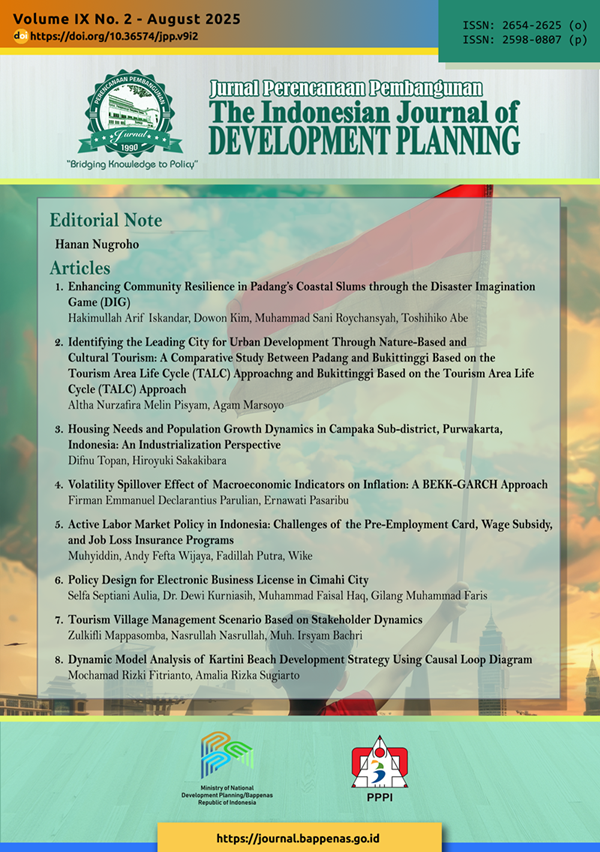
Active Labor Market Policy in Indonesia: Challenges of the Pre-Employment Card, Wage Subsidy, and Job Loss Insurance Programs
DOI:
https://doi.org/10.36574/jpp.v9i2.695Keywords:
Employment, Labor, Active Labor Market Policy, Pre-Employment Card, Wage Subsidy, Unemployment Insurance, IndonesiaAbstract
Active Labor Market Policy (ALMP) has become a key instrument in addressing employment challenges in Indonesia, particularly in the aftermath of the COVID-19 pandemic and the enactment of the Omnibus Law on Job Creation in 2020. This study analyzes the implementation, constraints, and impacts of three main ALMP programs—Pre-Employment Card (Kartu Prakerja), Wage Subsidy (BSU), and Job Loss Insurance (JKP)—on worker welfare. Employing a qualitative literature-based approach, data were gathered from academic journals, government reports, and ministerial-level statements. Findings indicate that these programs improved workers' skills and financial stability, though they also faced challenges such as low digital literacy, weak data validity, and suboptimal interagency coordination. The study recommends improved program design, enhanced digital infrastructure, and continuous evaluation to maximize long-term impacts.
Downloads
References
Al Ayyubi, M. S., Pratomo, D. S., & Prasetyia, F. (2023). Does pre-employment card program improve Indonesian youth labor market performance in pandemic era? Cogent Economics & Finance, 11(2). https://doi.org/10.1080/23322039.2023.2267752.
Almeida, R., Orr, L., & Robalino, D. (2014). Wage subsidies in developing countries as a tool to build human capital: Design and implementation issues. IZA Journal of Labor Policy, 3(1). https://doi.org/10.1186/2193-9004-3-12.
Anggara, R. T. (2024). Kartu Prakerja Program and Youth Employment: Gender-Specific Outcomes in Indonesia. Economics and Finance in Indonesia, 70(1), 49–62. https://10.47291/efi.2024.04.
Betcherman, G., Daysal, N. M., & Pagés, C. (2010). Do employment subsidies work? Evidence from regionally targeted subsidies in Turkey. Labour Economics, 17(4), 710–722. https://doi.org/10.1016/j.labeco.2009.12.002.
BPS. (2023). Keadaan Ketenagakerjaan Indonesia Agustus 2023. Badan Pusat Statistik.
BPS. (2024). Keadaan Ketenagakerjaan Indonesia Agustus 2024. Badan Pusat Statistik.
Card, D., Kluve, J., & Weber, A. (2018). What Works? A Meta-Analysis of Active Labor Market Policies. Labour Economics, 52, 48–77.
Hirawan, F. B., Fauri, A., Tobing, H. and Muhyiddin, M. (2023) “Kajian UU 11/2020 tentang Cipta Kerja Klaster Ketenagakerjaan: Studi pada Regulasi Pengupahan, PHK, dan Pesangon”, Jurnal Ketenagakerjaan, 18(1), pp. 1–13. https://10.47198/jnaker.v18i1.205.
Kluve, J. (2010). The Effectiveness of European Active Labor Market Programs. Labour Economics, 17(6), 904–918.
Ministry of Manpower, Republic of Indonesia. (2023). Indonesia Employment Report 2023. Pusat Pengembangan Kebijakan Ketenagakerjaan – Kemnaker RI. https://doi.org/10.47198/report.2023
Muhyiddin, M., Parmawati, R., Qomaruddin, M., Putra, F., & Sanusi, A. (2022). Design and Strategy for Welfare-to-Work Policy Implementation in Indonesia: Study on Multiple Activation, Strategy for Strengthening Service Provider Capacity and Response of Affected Groups of Pre-Employment Card (Kartu Prakerja) Program. Jurnal Perencanaan Pembangunan: The Indonesian Journal of Development Planning, 6(3), 277–291. https://doi.org/10.36574/jpp.v6i3.350.
Muhyiddin, M., Putra, F., Suryono, I. L., Yanwar, Y., Warsida, R. Y., & Ahmad Yani, R. A. (2022). Program Kartu Prakerja: Konsepsi dan Implementasi Kebijakan Welfare-to-work di Masa Pandemi Covid-19. Bappenas Working Papers, 5(1), 1 - 17. https://doi.org/10.47266/bwp.v5i1.123.
Muhyiddin, M. (2023). Post COVID-19 Pandemic Employment Challenges and Indonesia’s Opportunities to Take Advantage of the Demographic Bonus. Jurnal Ketenagakerjaan, 18(2), 97–108. https://doi.org/10.47198/jnaker.v18i2.253.
Muhyiddin, M., Trisnantari, S. A., Amrizal, M. D. R., Fauwziyah, F. ., Harsiwie, R. I. P., & Ardhana, N. R. (2024). Indonesia Employment in 2023: Labor Force Conditions and Policy Developments in the Early Stages of the Demographic Bonus. Jurnal Ketenagakerjaan, 19(1), 1–16. https://doi.org/10.47198/jnaker.v19i1.339.
Muhyiddin, M., Fefta Wijaya A., Putra F., & Wike. (2024). Indonesia’s Job Loss Insurance Program (JKP): Evaluating Challenges and Opportunities for Worker Welfare and Market Integration . The Journal of Indonesia Sustainable Development Planning, 5(3), 266-277. https://doi.org/10.46456/jisdep.v5i3.634.
Muhyiddin, M., Fefta Wijaya A., Putra F., Wike W. (2025A). Evaluating Indonesia’s Job Loss Insurance Program (JKP): Policy Implications for Financial Assistance, Labor Market Integration, and Reskilling. ICOPAG EAI. https://10.4108/eai.30-10-2024.2354824.
Muhyiddin, M., Wijaya, A. F. ., Putra, F. ., & Wike, W. . (2025B). Evaluating active labor market policy in Indonesia: A case study of the job loss insurance program. Edelweiss Applied Science and Technology, 9(6), 2751–2762. https://doi.org/10.55214/25768484.v9i6.8470.
Nguyen, P., Putra, F., Considine, M., & Sanusi, A. (2023). Activation through welfare conditionality and marketisation in active labour market policies: Evidence from Indonesia. Australian Journal of Public Administration, 82, 488–506. https://doi.org/10.1111/1467-8500.12602.
Nguyen, P., Considine, M., Putra, F. & Sanusi, A. (2024) Digital welfare-to-work in the global south: A case of Indonesian pre-employment card program. Australian Journal of Social Issues, 00, 1–17. Available from: https://doi.org/10.1002/ajs4.362
Project Management Office Kartu Prakerja (PMO Kartu Prakerja). (2023). Annual Report of the Prakerja Card Program 2023. Jakarta: PMO Kartu Prakerja.
Rahmatutik, N., & Laksmono, B. S. (2023). Active Labour Market Policy in Indonesia: Reviewing the Employment Policies and Programmes' Preparation. Indonesian Journal of Multidisciplinary Science, 2(9), 3237–3245. https://doi.org/10.55324/ijoms.v2i9.563.
Ragiliawan, Z. and Gunawan, B. T. (2021). Jaminan Kehilangan Pekerjaan (JKP) dalam Perspektif Belanja Negara. Jurnal Ketenagakerjaan, 16(1), pp. 48–60. https://10.47198/naker.v16i1.89.
Siregar, C. J. (2021). Bantuan Subsidi Upah: Evaluasi Dampak terhadap Pekerja Formal. Journal Bappenas, 7(2), 56–78. Retrieved from journal.bappenas.go.id
Styawati, N., Hendrastuty, N., Isnain, A. R., & Rahmadhani, A. Y. (2021). Analisis Sentimen Masyarakat Terhadap Program Kartu Prakerja Pada Twitter Dengan Metode Support Vector Machine. Jurnal Informatika: Jurnal pengembangan IT (JPIT), 6(3), 150–158.
Suryahadi, A., Al Izzati, R., & Suryadarma, D. (2020). The Impact of COVID-19 Outbreak on Poverty: An Estimation for Indonesia. SMERU Working Paper. https://smeru.or.id/sites/default/files/publication/wp_covid19impact_draft.pdf.
Tobing, H., Muhyiddin, M., Sari, A. P., Rizki, F. A. R., & Al Ayubbi, S. A. (2022). Improving the Distribution Policy of the Wage Subsidy Assistance Program (Bantuan Subsidi Upah/BSU). Bappenas Working Papers, 5(2), 226 - 240. https://doi.org/10.47266/bwp.v5i2.170.
Van Berkel, R. (2017). State of the art in frontline studies of welfare-to-work: A literature review. Frontline delivery of welfare-to-work policies in Europe, 12-35.
Warsida, R. Y., Yanwar, Maryani, Y. T. S., Annazah, N. S., & Muhyiddin M. (2023). Analisis Dampak dan Manfaat Program Jaminan Kehilangan Pekerjaan (JKP) untuk Kesejahteraan Tenaga Kerja di Indonesia. Ministry of Manpower, Republic of Indonesia. https://doi.org/10.47198/pwp.v1i2-12.
Downloads
Published
Issue
Section
License
Copyright (c) 2025 Jurnal Perencanaan Pembangunan: The Indonesian Journal of Development Planning

This work is licensed under a Creative Commons Attribution-NonCommercial-ShareAlike 4.0 International License.
This open-access article is distributed under the terms of the Creative Commons Attribution-NonCommercial-ShareAlike 4.0 International License. Copyright © The Indonesian Journal of Development Planning